Venture capital & angel investors
By Anchit Shrivastava ·
You passed on her at pre-seed. Her Series A closes this week, oversubscribed. Dhaga holds why you passed, who can get you back in, and each one's note.
The moment this earns its keep
An angel you trust says the round you passed on at pre-seed is now oversubscribed and closing fast, with a sliver of allocation left for a fund that can help on distribution. You have about a day to decide. What you thought in 2024, what changed since, and who can get you back in the room all need to be in front of you in the next ten minutes — and the thing holding them wasn't you.
The fact the deal turns on
Meet Amara Diallo, founder and CEO of Helios Solar — a seeded demo contact, the kind of founder you track for years before the timing is right.
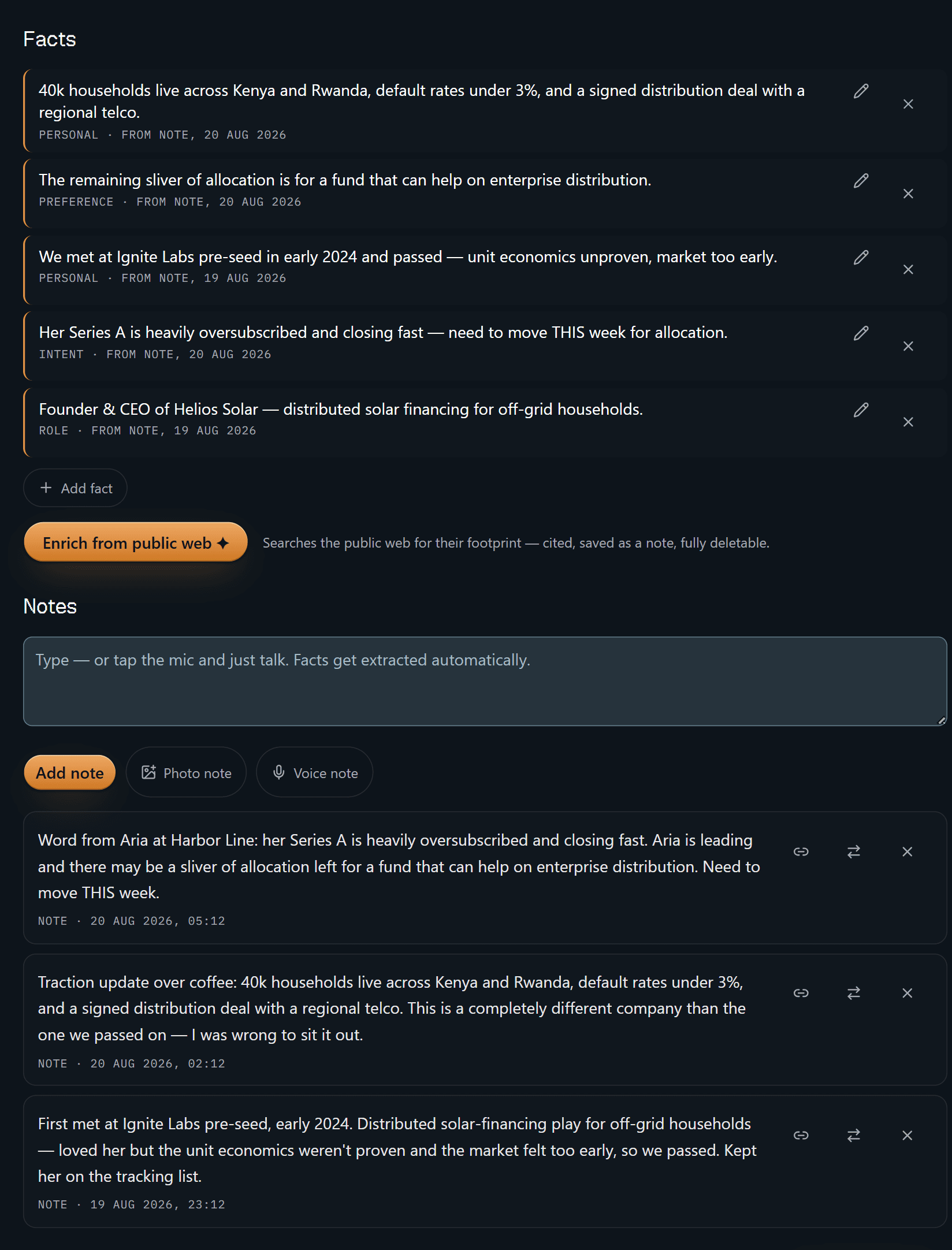
Five facts, and every one carries a receipt: FROM NOTE, 19 AUG 2026,
FROM NOTE, 20 AUG 2026. The dates differ because the notes differ. "We met at
Ignite Labs pre-seed in early 2024 and passed — unit economics unproven, market
too early" traces to the note you wrote after that first meeting. "Her Series A
is heavily oversubscribed and closing fast — need to move THIS week for
allocation" traces to a different note, written a day later, after Aria told
you. And the traction line — 40k households live across Kenya and Rwanda,
default rates under 3%, a signed distribution deal with a regional telco — sits
above the coffee note it was pulled out of, the one that ends "I was wrong to
sit it out."
Scroll and the notes are right there under the facts, in full, so a claim is never more than one hop from the sentence you actually wrote. Delete a note and the facts derived from it are tombstoned with it. A claim with no source isn't worth keeping — least of all in a decision you have a day to make.
That is the whole product in one screen. The rest is convenience.
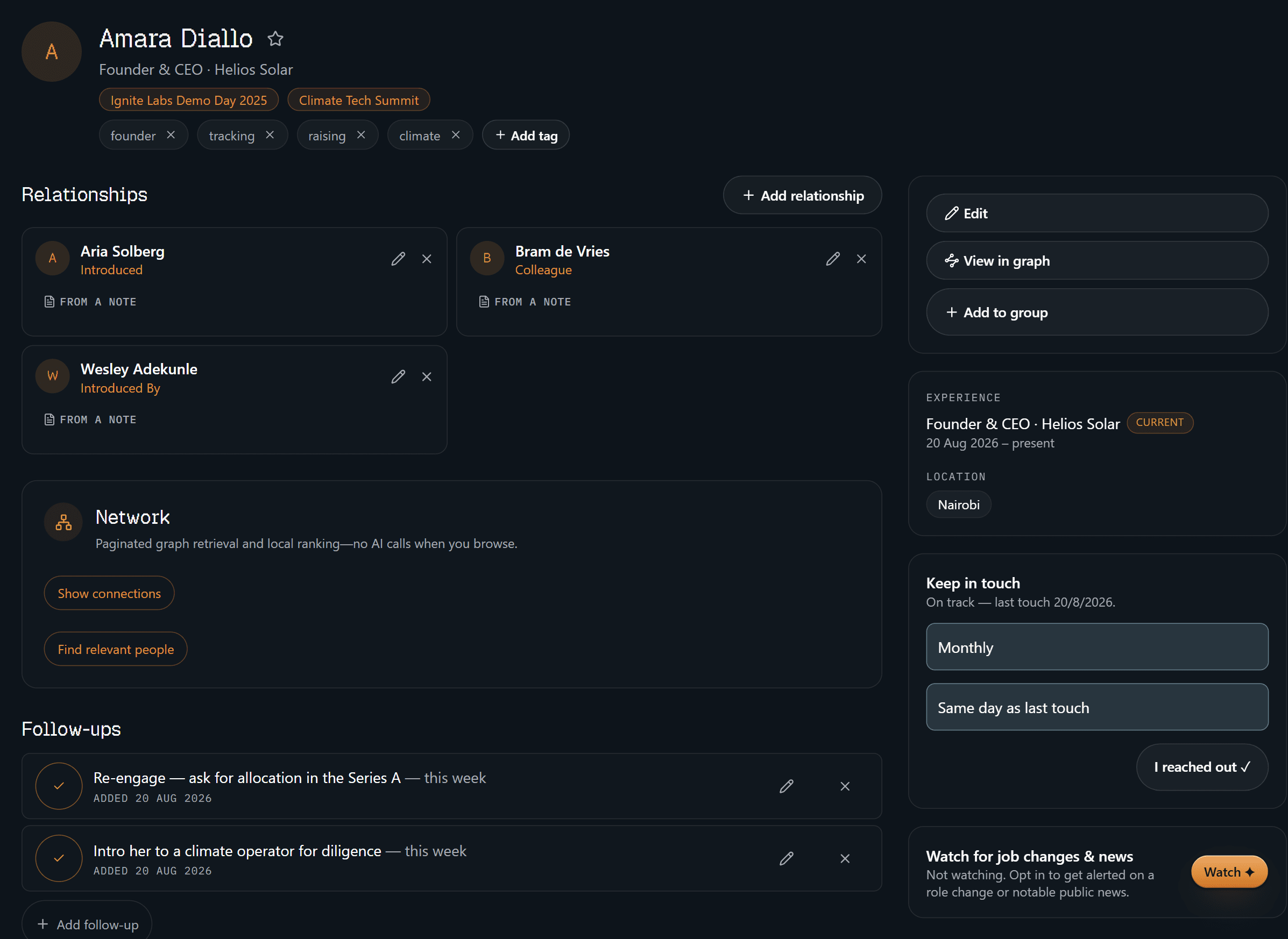
The identity block is the boring, load-bearing half: founder and CEO of Helios
Solar, tagged founder tracking raising climate, met at Ignite Labs Demo
Day 2025 and the Climate Tech Summit, based in Nairobi, on a monthly cadence
you're currently on track with. Three relationships, each stamped FROM A NOTE
— an introduction made, an introducer, a colleague — so none of them is a
half-memory. Two follow-ups sit at the bottom, both due this week: ask for
allocation in the Series A, and intro her to a climate operator for diligence.
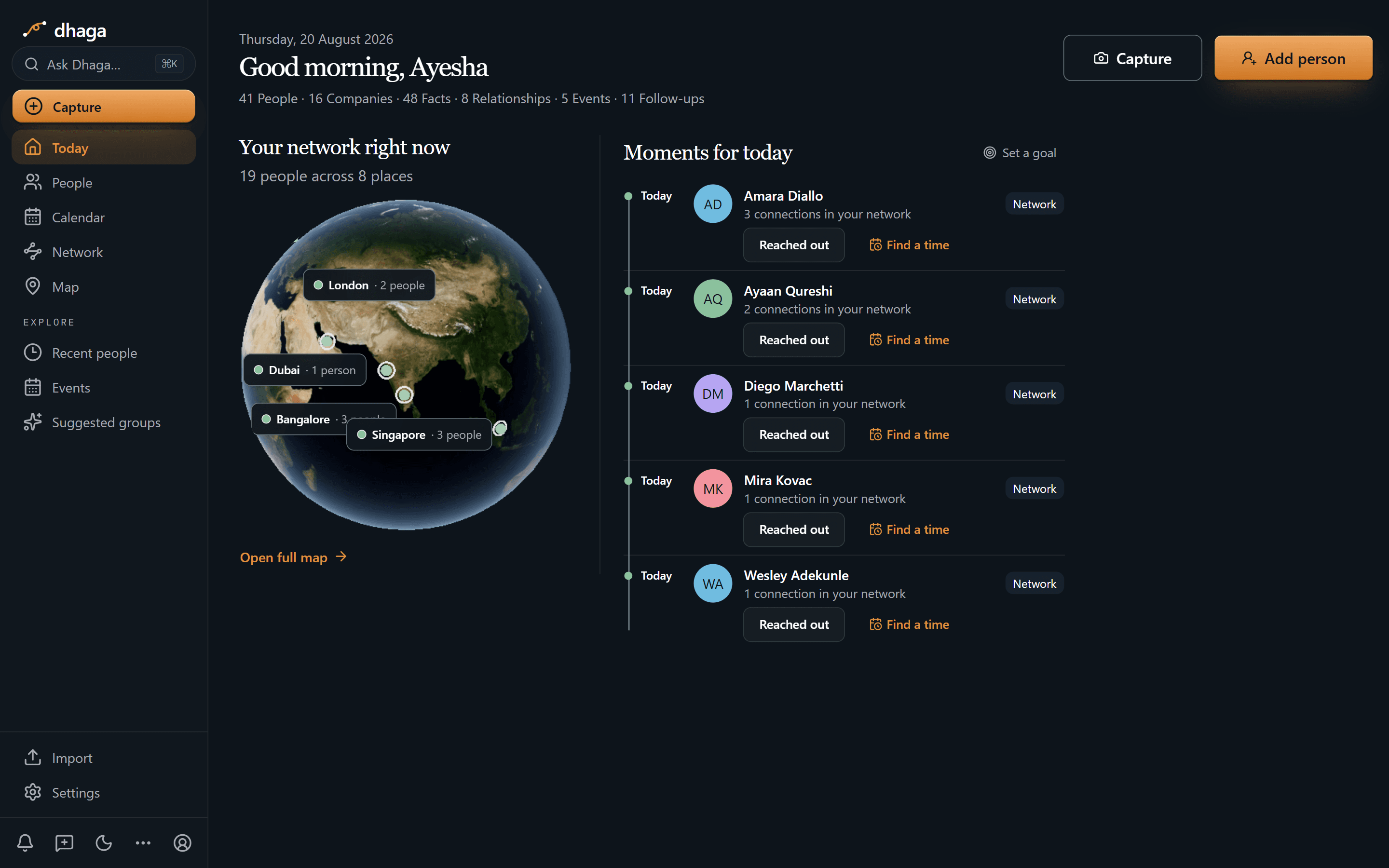
Amara is at the top of today's moments on the cadence you set, alongside four
other people you meant to stay close to, each with one click to log that you
reached out or to find a time. The strip along the top is the graph at a glance
— 41 people, 16 companies, 48 facts, 5 events, 11 follow-ups. What you owe any
one of them isn't on this screen: it lives on their profile, and in one
Day/Week/Month view at /app/plan.
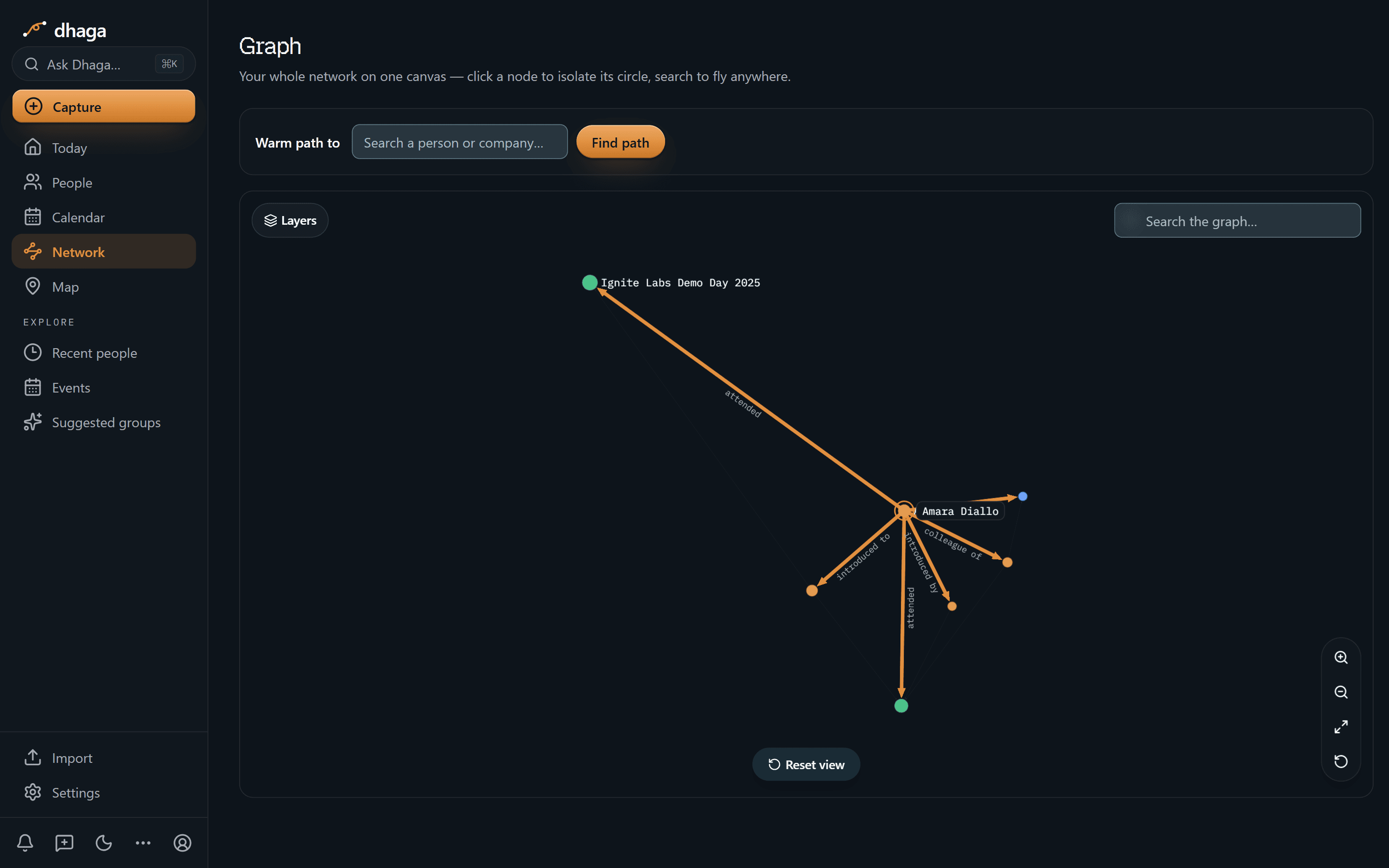
One hop out from Amara and every line says what it is: attended, introduced by, introduced to, colleague of. Her neighbours stay unlabelled dots until you click one and it becomes the new centre — except the event, Ignite Labs Demo Day 2025, which is where the whole thread started. Above the canvas, "Warm path to…" takes a name and finds the route. That's the difference between "I think someone introduced us" and knowing which thread to pull.
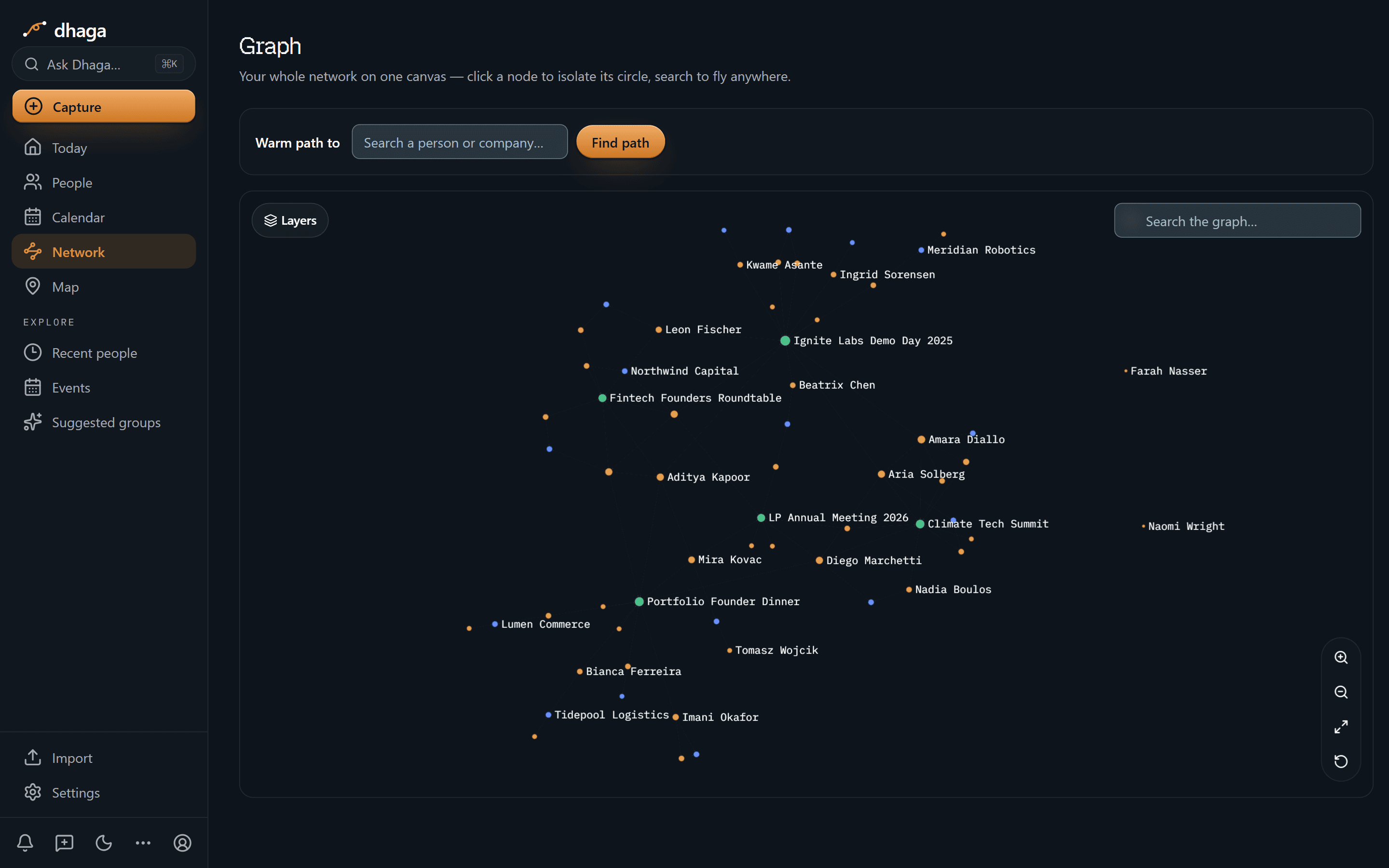
Zoom out and it's people, companies and events in one picture — Northwind Capital, Meridian Robotics, Lumen Commerce and Tidepool Logistics sitting among the founders, operators and angels you know, with the five events threading them together. Which is an honest picture of what deal flow actually is: not a pipeline, a web.
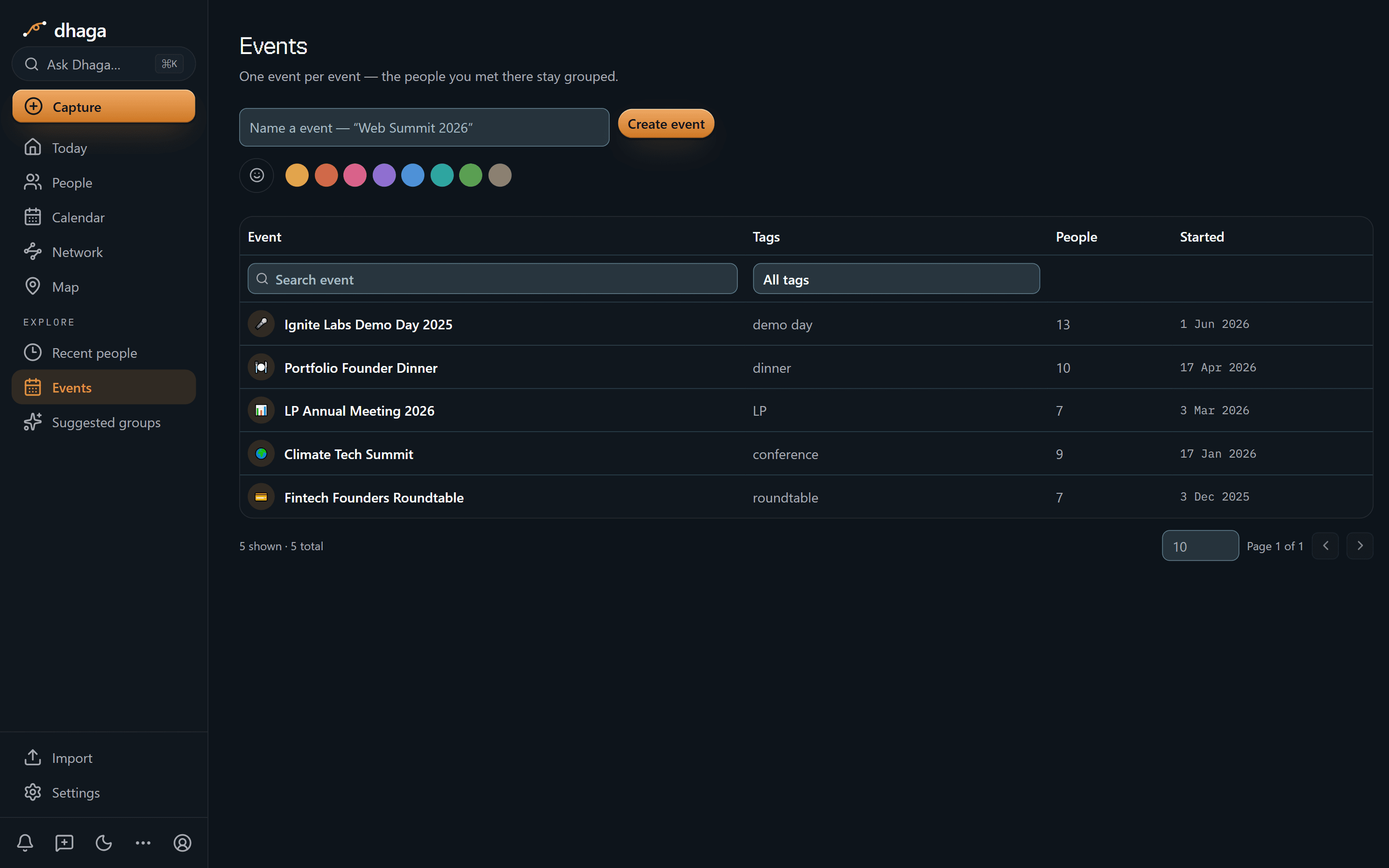
Ignite Labs Demo Day 2025 with 13 people, the Portfolio Founder Dinner with 10, the LP Annual Meeting with 7. Each one keeps the people you met there grouped, so "we met at demo day" stays a fact rather than a hunch.
The 60-second version
- "Who can get me a warm intro to this founder?" → a real graph of who knows whom, with a "Warm path to…" search over it.
- Is that connection actually real? → every relationship shows the note it was recorded in, or admits it has none.
- You passed on them in 2024 and can't recall why → the thesis, the concern and the date, still attached to the person.
- Debriefs never get written → browser voice capture in the car, spoken before the next meeting starts.
- Demo-day badges pile up → scan front and back in one go, merged into one contact.
- Half your deal flow arrives on WhatsApp → forward the message and it becomes a note on the right founder.
- Co-investors go quiet for a year → keep-in-touch cadence, plus
/app/plan: one Day/Week/Month/List view over follow-ups, your events and a connected calendar. - You already do diligence inside Claude → point it at your own graph over MCP.
Getting it in
- Voice, in the browser, in the car after the meeting — spoken instead of written up.
- Badge or card scan at a demo day, front and back, into one contact.
- WhatsApp and Telegram — forward the intro thread or DM the bot; every inbound message is listed at
/app/settings/messaging/log(guide). - Browser extension and web quick-add while you're researching a company.
- Import from vCard or CSV, or sync Google and Outlook contacts.
Getting it out
Ask in plain English, answered only from your notes and graph:
- "Who in my network can introduce me to the founder of Helios?"
- "What did I note about this founder in 2024, and why did I pass?"
- "Which co-investors have I not spoken to since the last close?"
If there's no path in your notes, Dhaga says so rather than inventing a connection that would embarrass you in the ask.
Or point your own AI tools at it. Dhaga runs an MCP server, so Claude, Cursor or ChatGPT can read your graph directly — build the diligence brief or the co-investor list in the tool you already work in, over your real history instead of a pasted summary. It's on Pro and above, and reading costs no AI credits. How to connect it.
The warm path, with a receipt
The highest-leverage question in venture is who can make the intro. It's also the one most likely to be wrong from memory.
Dhaga answers it from edges you actually recorded, and each one shows whether a
note stands behind it. On Amara's profile all three read FROM A NOTE; where no
note names both people, the edge says so plainly instead of quietly implying
one. That's the difference between a confident ask and a cold email in a warm
coat. Delete the note and the relationships derived from it are tombstoned with
it, so the graph never keeps a claim it can't source.
The founder you passed on
Every investor has this story. Eighteen months ago the market was wrong, you passed politely, and now they're raising a round everyone wants.
Capture is cheap enough to do every time — a voice note in the car, a badge scan at the demo day — so when the name resurfaces you get the thesis you had, the concern you flagged and the mutual connections back. You re-engage as someone who remembers them, not someone starting from zero. That's usually the whole difference in getting allocation.
What we don't do
- We're not your fund's deal system. Keep the pipeline, IC memos and LP reporting where compliance expects them. Dhaga holds the people, not the process.
- We don't watch the web on our own. Watching does exist, but one contact at a time and opt-in: turn on Watch for someone and a daily sweep looks for a role change or notable public news. It needs a Pro or Power plan, stops at five watched contacts, and what it finds arrives as an alert you can dismiss — or save as a note, which is then deletable like any other. Everyone you didn't tick is never looked up. The Enrich from public web button on a profile works the same way: you press it, it cites what it finds, and it saves as a note you can delete.
- No full mobile app yet — web, extension and WhatsApp/Telegram are the capture surfaces.
What it costs
The free tier is real: 10 AI credits a month, and manual capture stays unlimited. Pro is ₹499/month, or $4.99 internationally, with Power above it. /pricing is the one place that shows what you would pay today, including any offer running there.
One missed allocation costs more than a decade of this. Start free and capture your next founder call by voice.
Discussion
Recruiting & executive search
A Staff role opens that matches what a passive candidate told you six weeks ago. Dhaga remembered her terms, her timing, and which call each came from.
Founders & startup CEOs
An investor said come back at $10k MRR. You just crossed $12k. Dhaga is the thing that remembered who said it, when, and what you promised them on the way out.