Founders & startup CEOs
By Anchit Shrivastava ·
An investor said come back at $10k MRR. You just crossed $12k. Dhaga is the thing that remembered who said it, when, and what you promised them on the way out.
The moment this earns its keep
A partner at Northwind told you, in the room, to come back when you hit $10k MRR. A few weeks and several hundred context-switches later you crossed $12k — and the thing holding her exact wording, the note it came from and the two follow-ups you owe her wasn't you.
The fact the raise turns on
Meet Priya Raghunathan, a partner at Northwind Ventures — a seeded demo contact playing the lead you're courting for your seed round.
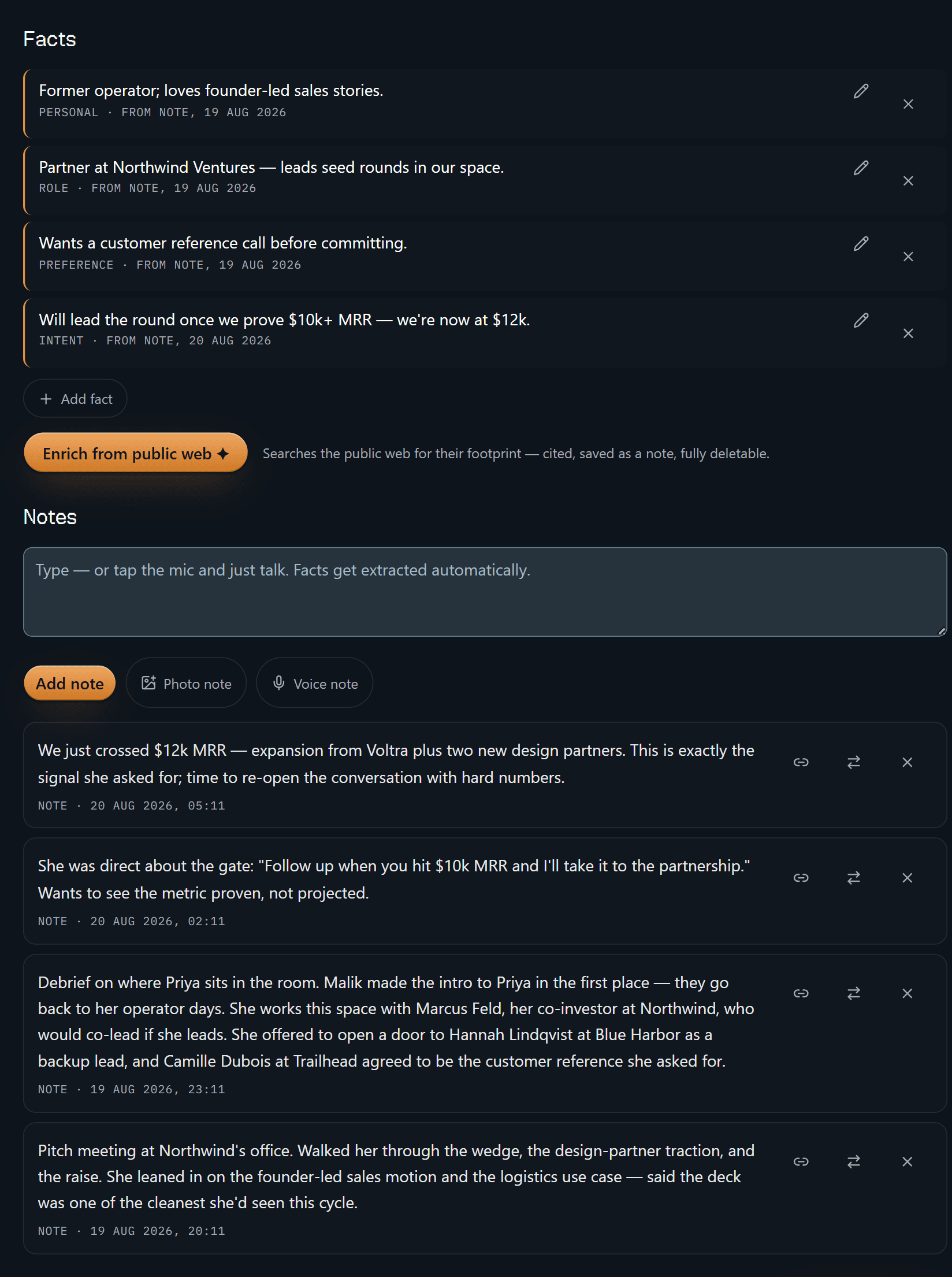
Every fact carries a receipt: the note it came out of, sitting right underneath it. "Will lead the round once we prove $10k+ MRR" isn't something you half remember from a call — it's a line that traces back to the debrief it came from, so when you re-open the conversation you can quote her to herself and be right. Delete the note and the facts derived from it are tombstoned with it. A claim with no source isn't worth keeping.
That is the whole product in one screen. The rest is convenience.
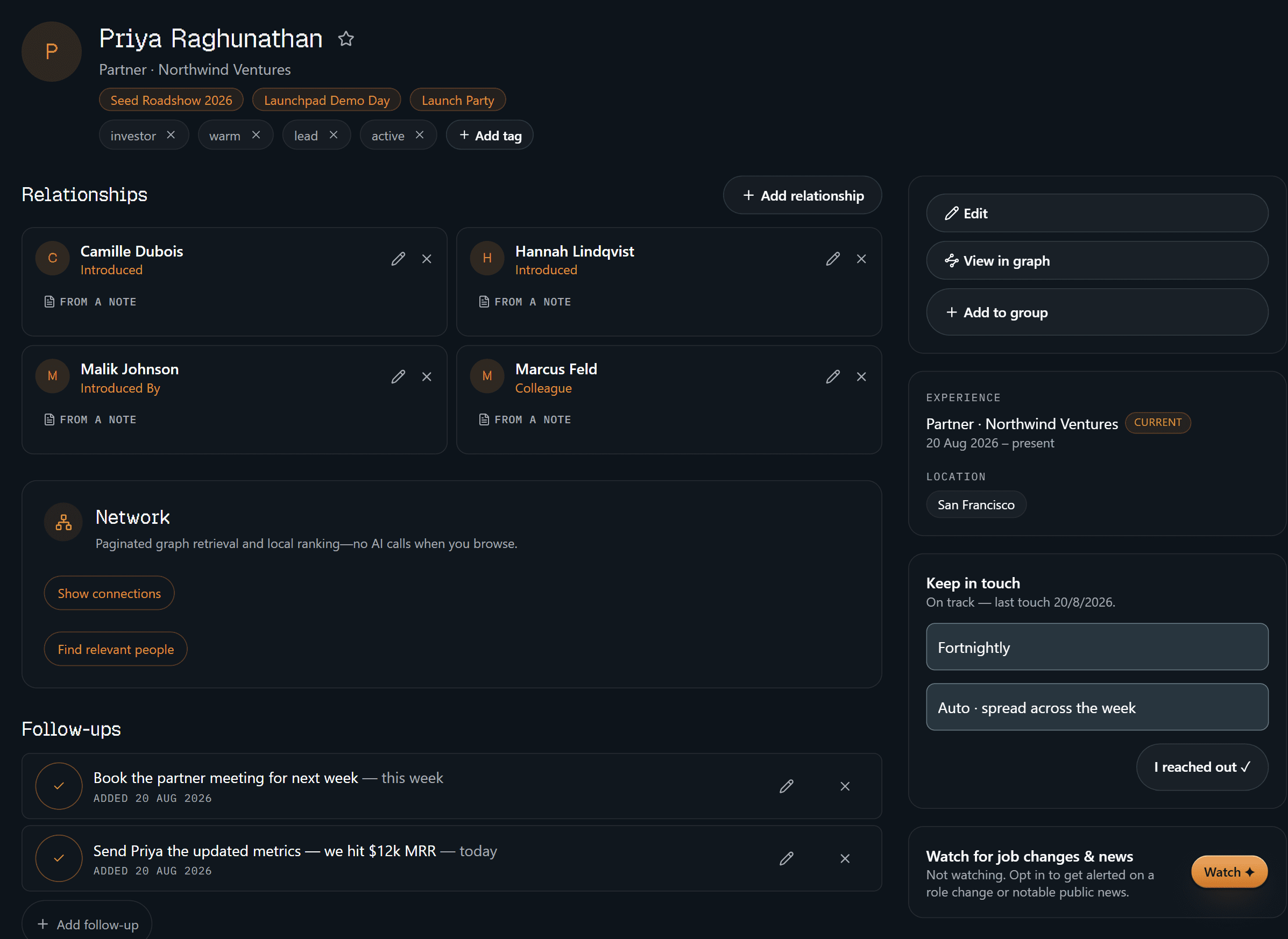
The identity block is the boring, load-bearing half: what she does, how you've filed her, how often you meant to be in touch, and the career behind the name. It's what you want on screen in the thirty seconds before the call connects.
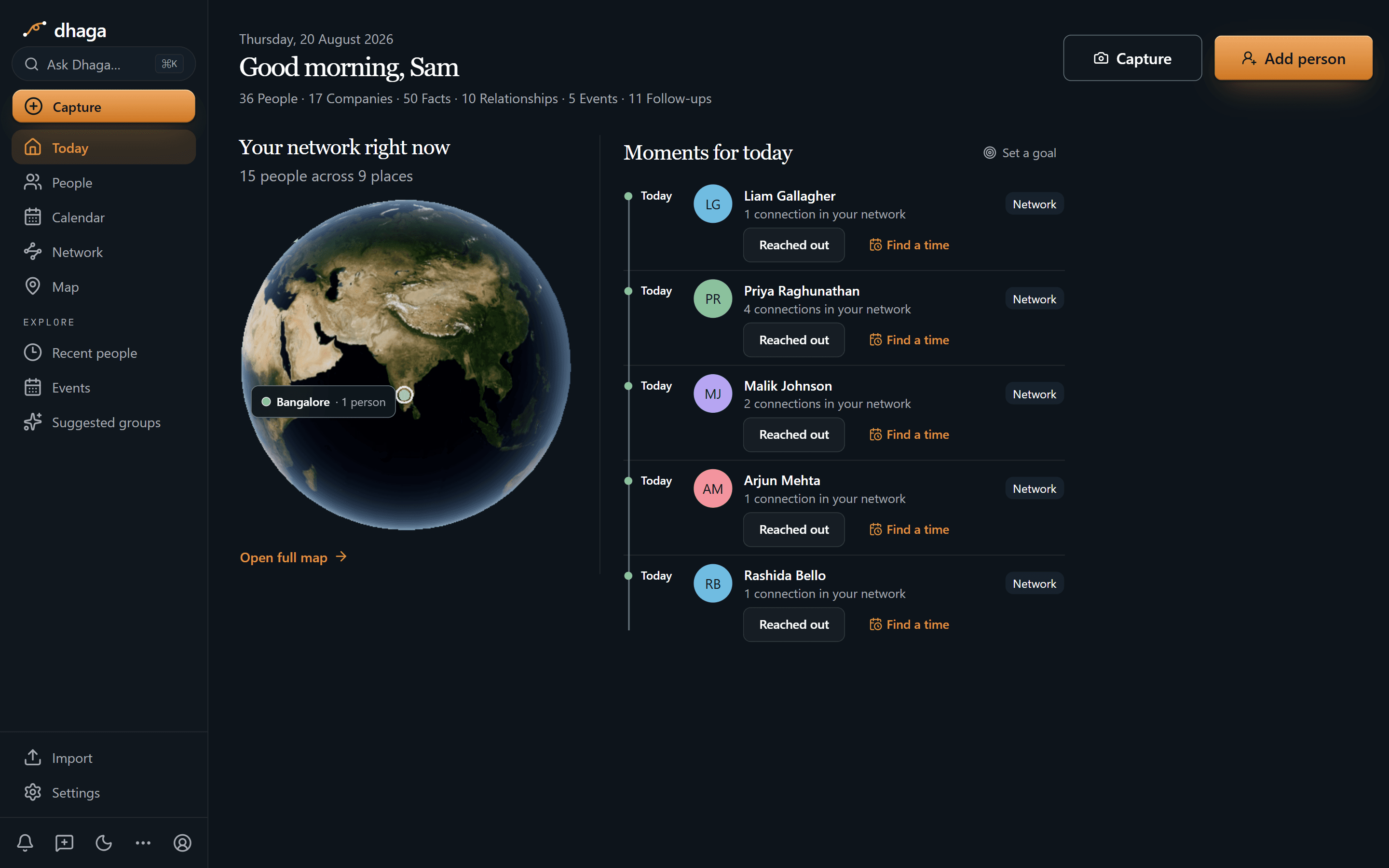
Priya is in today's list on the cadence you set for her, alongside four other people you meant to stay close to. The strip along the top is the graph at a glance — 36 people, 50 facts, 11 open follow-ups. Nothing here is a to-do that lost its context: every row is a person, and what you owe each of them sits on their profile and in one Day/Week/Month view at /app/plan.
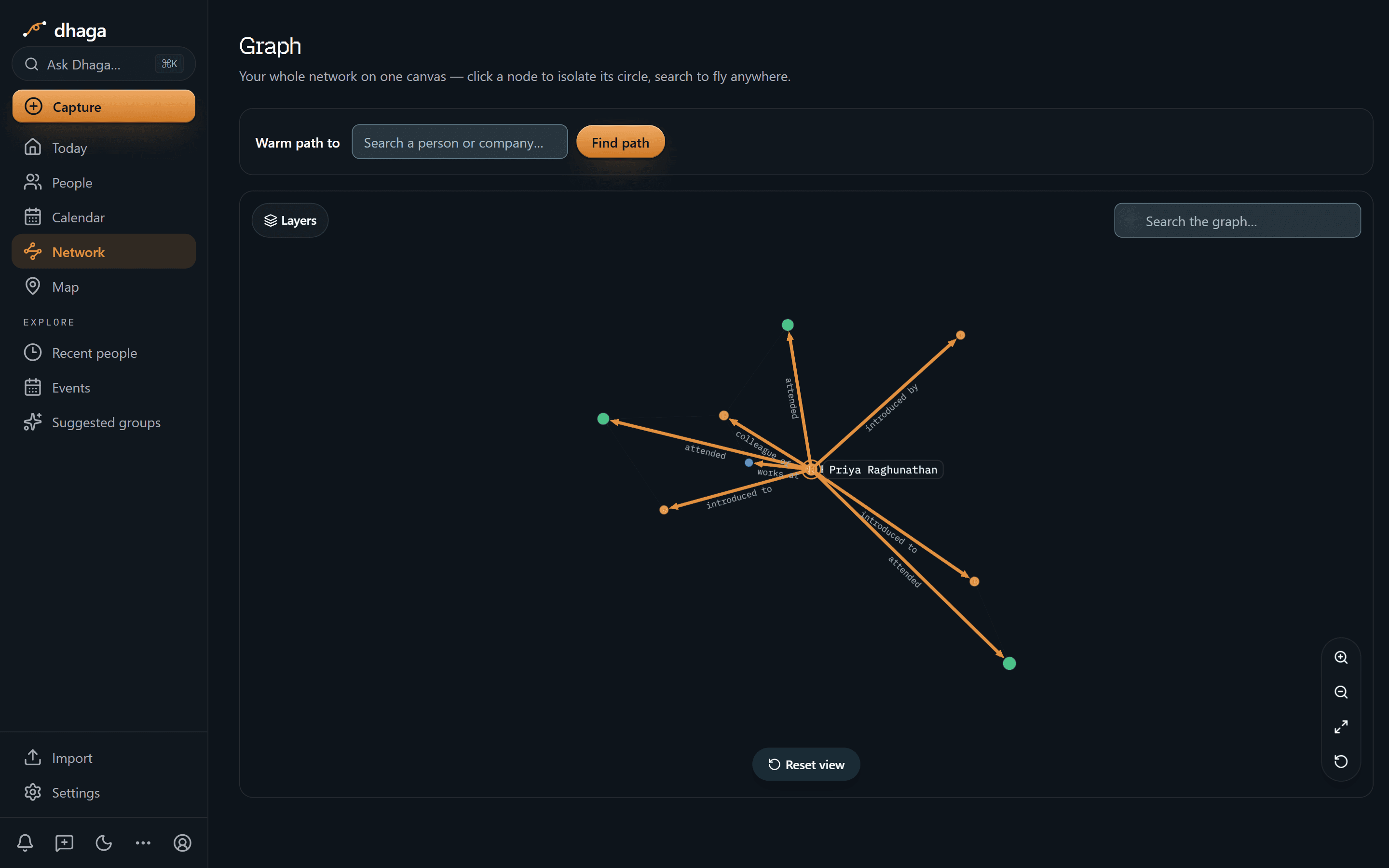
One hop out from Priya, and every line is labelled with what it is: introduced by, colleague of, introduced to, attended. Click any node and it becomes the centre, with its own circle read the same way. That's the difference between "I think someone introduced us" and knowing which thread to pull.
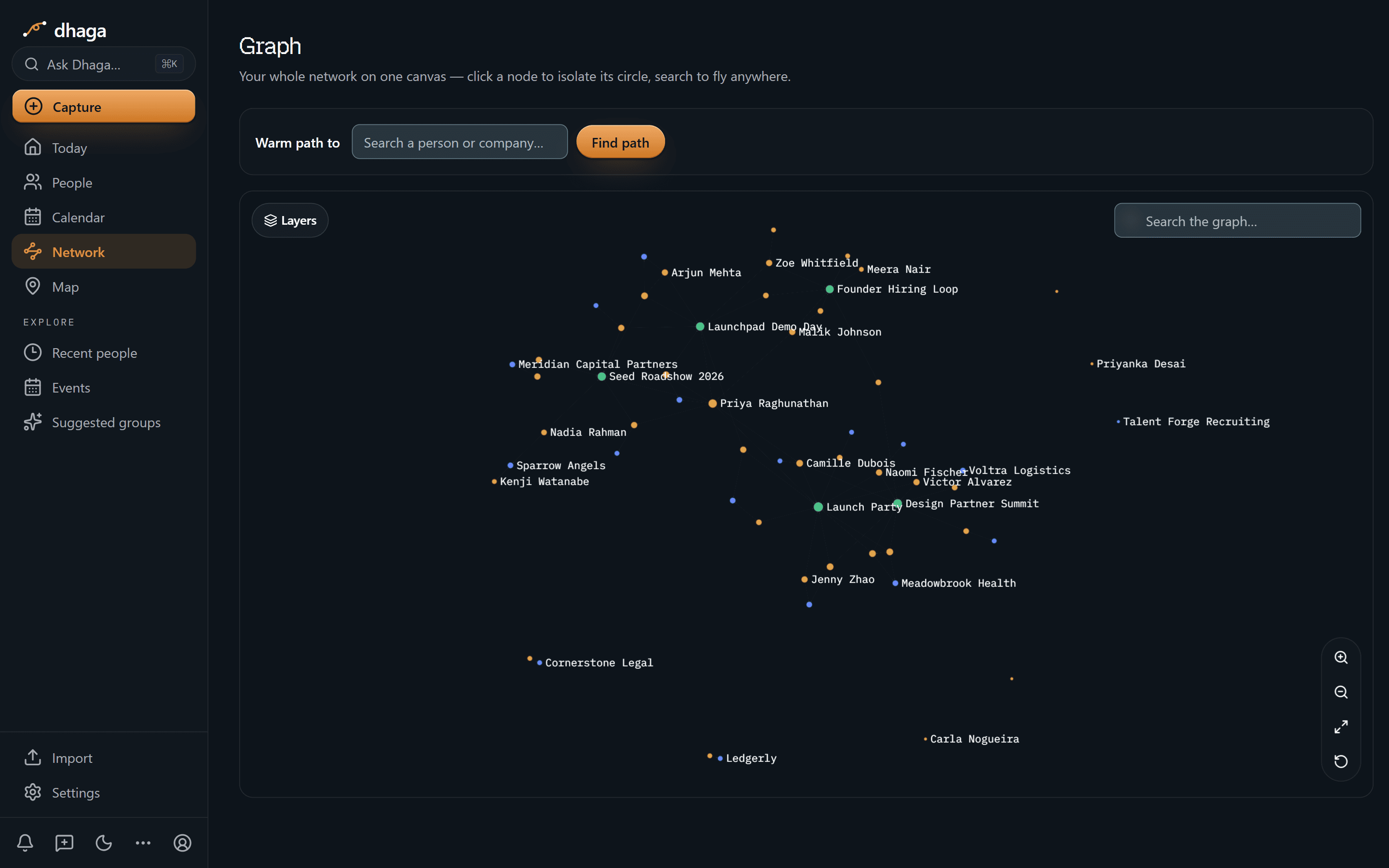
Zoom out and it's five networks in one picture — investors, advisors, candidates, design partners, press. Which is an honest picture of what a founder's address book actually is.
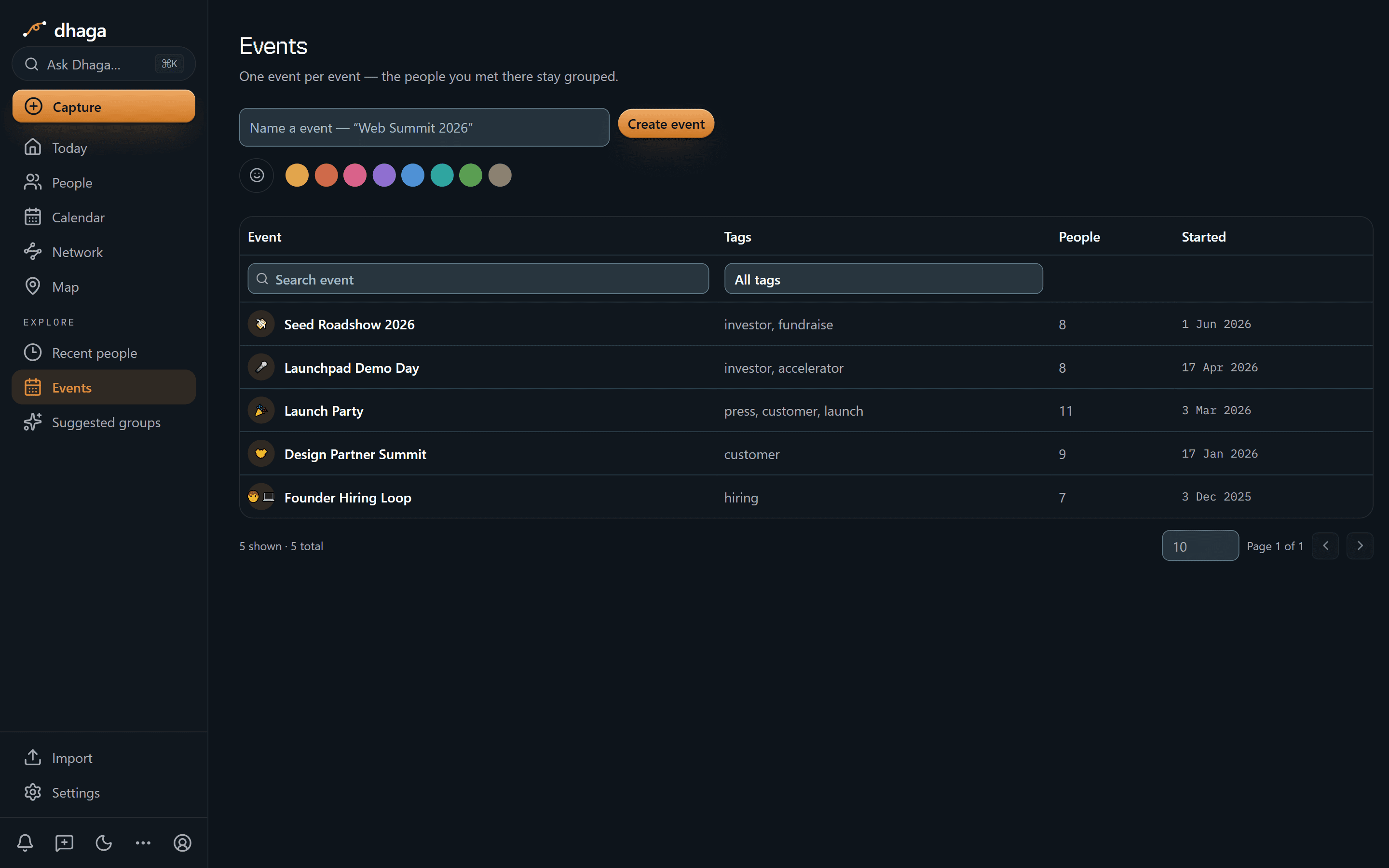
The roadshow, the demo day, the launch party: each one with the people who were there, so "we met at demo day" stays a fact rather than a hunch.
The 60-second version
- "Follow up when you hit $10k MRR" → a fact on that investor's profile, with a receipt back to the call it came from.
- You never write the note after the meeting → browser voice capture, spoken instead of typed.
- Demo-day cards pile up in a pocket → scan front and back in one go, merged into one contact.
- The conversation already happened on WhatsApp → forward it and it becomes a note on the right person.
- Who intro'd me to whom? → a real graph edge, not a memory — and the edge shows its source note.
- Five promises, five people, zero system →
/app/plan: one Day/Week/Month/List view over follow-ups, your events and a connected calendar. - "Which angels have sent me the most intros?" → Ask Dhaga in plain English, answered only from your notes.
- You already live in Claude or Cursor → point them at your own graph over MCP.
Getting it in
- Voice, in the browser, walking out of the meeting — spoken straight into a note.
- Card or badge scan at demo day, front and back, into one contact.
- WhatsApp and Telegram — forward the thread or DM the bot; every inbound message is listed at
/app/settings/messaging/log(guide). - Browser extension and web quick-add when a warm intro lands in your inbox.
- Import from vCard or CSV, or sync Google and Outlook contacts.
Getting it out
Ask in plain English, answered only from your own notes and graph:
- "Which investors said to follow up after we hit $10k MRR?"
- "Who introduced me to Priya, and what did I promise them?"
- "Who did I meet who might be open to an early engineering role?"
When Dhaga doesn't know, it says so instead of inventing an answer — which is the only version of this that's safe to run a raise on.
Or point your own AI tools at it. Dhaga runs an MCP server, so Claude, Cursor or ChatGPT can read your graph directly. Draft the monthly investor update in the tool you already work in, against your actual notes rather than a summary you pasted in. It's on Pro and above, and reading costs no AI credits. How to connect it.
Running a raise without dropping a thread
A raise is thirty parallel conversations at thirty different stages, each with its own promised follow-up. Miss one and you don't get a rejection, you get silence — which is worse.
Capture the debrief before the next meeting starts, then let the daily brief tell you what you owe whom. Every fact carries a receipt, so when you tell an investor "you asked for the retention curve in March", you can trust the March. Follow-up drafts get the note out of your head and into a send box.
One network, five jobs
The angel who'd write a cheque, the staff engineer who might leave BigCo, the design partner shaping your roadmap, the reporter covering your space — one Rolodex, five jobs, one tired brain.
Dhaga holds it as a single graph, so the investor who is also an advisor who also intro'd you to a customer stays one person, remembered whole. Groups, tags and companies slice it when you need to; keep-in-touch cadence flags the angel you last spoke to four months ago, before the ask goes cold.
What we don't do
- We're not your fundraising CRM or your data room. Dhaga holds the people, not the process.
- We don't monitor your address book. Job-change and news alerts do exist, but one contact at a time and opt-in: turn on Watch for someone and a once-a-day job works through the ticked people, each re-checked every few days. A hit arrives as an alert on their profile with its source link — you file it as a note or dismiss it, and nothing is written into your graph unattended. It needs a Pro or Power plan, stops at five watched contacts, and everyone you didn't tick is never looked up. Everything else, Dhaga knows because you told it.
- No full mobile app yet — web, extension and WhatsApp/Telegram are the capture surfaces.
What it costs
The free tier is real: 10 AI credits a month, and manual capture stays unlimited. Pro is ₹499/month, or $4.99 internationally, with Power above it. /pricing is the one place that shows what you would pay today, including any offer running there.
Your network is the asset. Start free and stop being the single point of failure.
Discussion
Venture capital & angel investors
You passed on her at pre-seed. Her Series A closes this week, oversubscribed. Dhaga holds why you passed, who can get you back in, and each one's note.
Management consultants & professional-services firms
Your former client resurfaced as a COO with a mandate. Dhaga remembered the turnaround you ran, who put you before that board, and the one-pager you owe.