The bill is the model, not the servers
By Anchit Shrivastava ·
In an AI product, inference is the P&L. How we found Dhaga's real cost driver, and the guardrails that stop one heavy user costing $7,200 a month.
The short version
Everyone building an AI product worries about their server bill. It's the wrong thing to worry about. When we modelled Dhaga's real cost to serve, the infrastructure came out to $0.18–$0.41 per user per month — and it drops as we grow. The model inference did not. Left uncapped, the AI features could cost 3–8× the entire infrastructure bill, and one pathological "enrich my whole address book" action could run to $7,200 in a month for a single user.
The engineering lesson: in an AI product, your unit economics live and die by which model runs, how often, and whether a user can trigger unbounded work. This is how we found that out, and the guardrails we built into the code so the worst case can't happen.
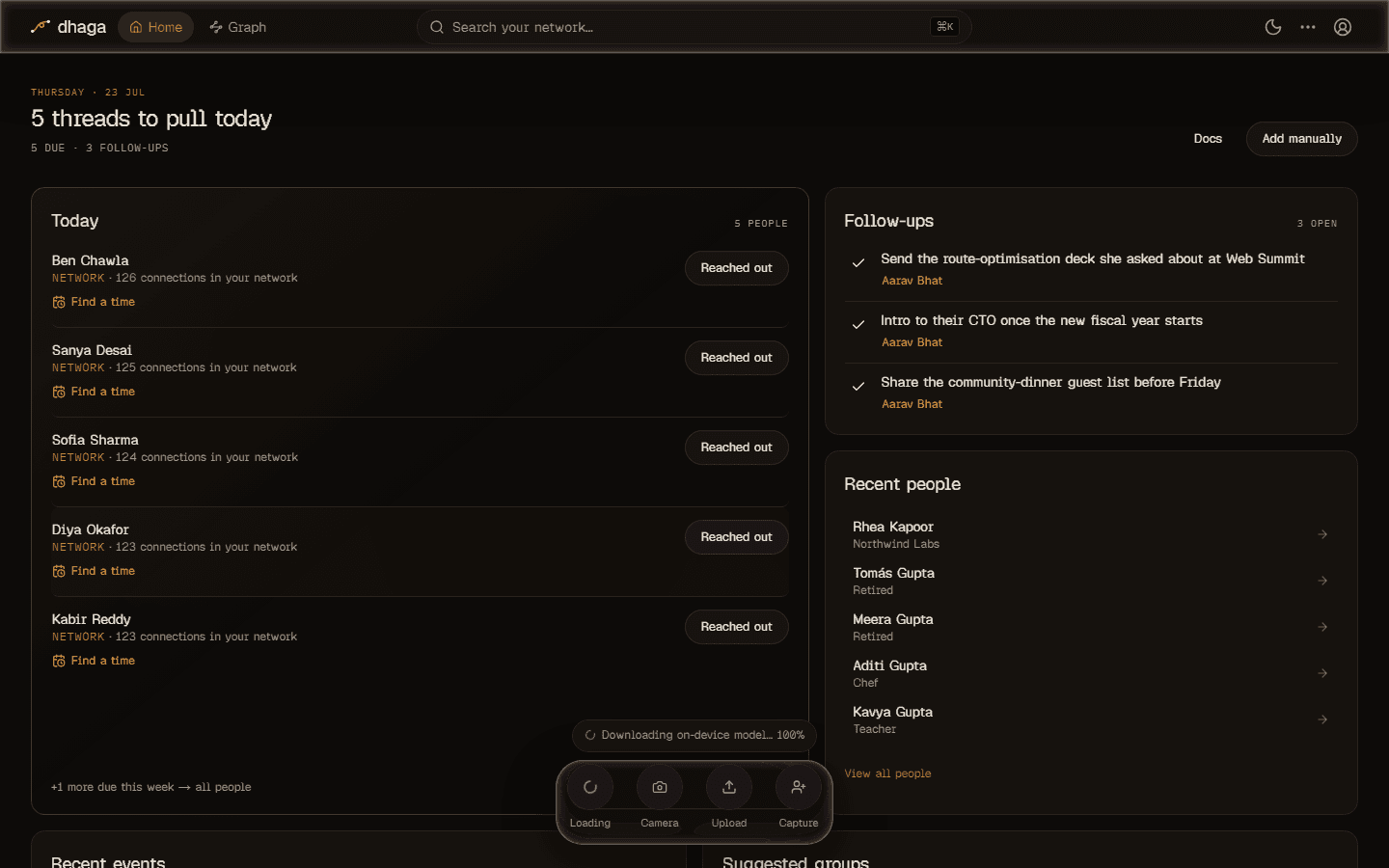
The rest of this post is the deep dive: the cost trace we ran through the actual call sites, the tiered-inference architecture, and the specific caps in the code. File paths refer to the real files.
Why the intuition is wrong
Traditional SaaS cost scales with infrastructure: more users, more database, more compute, bigger bill — and you fight it with caching, cheaper instances, and read replicas. That reflex is actively misleading for an AI product, because the cost curve has a completely different shape.
We wrote the whole analysis up in Cost & scaling on AWS. The headline number: across 1k / 10k / 100k users, infrastructure runs $0.18–$0.41 per user/month and falls with scale (fixed costs amortise, caches warm). Claude usage, by contrast, scales linearly with activity and, if proactive AI runs uncapped, dwarfs the infra bill.
So the thing to engineer hardest isn't the database. It's metering and capping the model.
Finding the real cost driver
The first cut of our cost model used napkin numbers per action. That's not good
enough to price a product on, so we did something more honest: we traced every
actual LLM call site in the codebase and re-derived the cost of each user
action from the real model, the real token shape, and the real cadence. The
prompt builders live in
packages/core/src/llm/prompts/
and the call sites in
apps/web/src/lib/ai/.
The per-action costs that fell out (standard Anthropic rates — Haiku 4.5 at $1/$5 per MTok, Sonnet 5 at $3/$15, Batch −50%):
| Action | Model | ~Cost |
|---|---|---|
| Card / badge scan | Haiku + vision | ~$0.002 |
| Note extraction | Haiku | ~$0.002 |
| Natural-language search (plan + answer) | Haiku + Sonnet | ~$0.006 |
| Follow-up draft | Sonnet | ~$0.004 |
| Pre-meeting brief | Sonnet | ~$0.006 |
| Enrichment (web search) | Sonnet + native web-search tool | ~$0.02–0.04 |
| Watchlist rescan | Haiku Batch + search | ~$0.006–0.011 |
Superseded: nothing runs on Haiku any more
This table is what we measured in July 2026, and it is left as measured rather than rewritten — rewriting it would destroy the record of what was actually observed. But as of 2026-09-04 the extraction tier moved to Sonnet 5, so every row above that says Haiku is now priced off a model Dhaga no longer calls. Sonnet is a flat 3.0× Haiku on identical tokens (the ratio is just $3/$1 in and $15/$5 out, so no measurement can move it), which is the multiplier to read those rows with. The shape of the finding is what survived and it is the part that mattered: the cheap high-frequency rows still aren't the problem, and the scheduled per-contact rows still are.
Notice which rows are an order of magnitude bigger. The cheap, high-frequency stuff (scans, extraction) is not the problem. The expensive rows are the ones that (a) call the big model, (b) hit an external web-search API, and (c) can run per contact, on a schedule, without a human in the loop. That last property is the dangerous one.
The key insight: search cost is flat, monitoring cost is not
A subtle finding that shaped the whole design: per-search cost is roughly flat regardless of how big your contact book is. Vector search returns the top ~20 matches whether you have 200 contacts or 30,000. So a giant address book doesn't inflate search — it inflates storage and the scope of proactive monitoring.
That means the cost to serve the same user spans two orders of magnitude depending purely on one product decision — how much of their book we proactively watch and how often:
- ~$8/month if we watch ≤50 contacts, weekly.
- ~$105/month at 10% of a big book, weekly.
- ~$7,200/month — plus a ~$900 one-time spike — if we nightly-scan the whole book and run "enrich everything" on import.
Same user. The difference is entirely guardrails.
Tiered inference: never call a big model where a small one passes
The first structural defence against cost is architectural: a strict hierarchy of cheapest capable tier first, encoded in the LLM gateway so callers depend on an interface, not a provider.
- Free on-device primitives where they exist (OCR, transcription, embeddings) — $0 to us.
- The smallest capable model — with the weight on capable. Extraction and parsing went to Haiku with a Zod-derived structured-output schema — never free-text parsing; search reasoning and drafts, which actually need the headroom, went to Sonnet. Since 2026-09-04 both tiers resolve to Sonnet 5: the extraction tier turned out not to be doing cheap mechanical parsing at all, but making judgement calls on the user's own data, and the smaller model was measurably not good enough at them — it could not read a business card Sonnet read perfectly from the identical pixels. The tier split is still in the code rather than collapsed, so the day a small model passes those evals, restoring it is one table edit and no call-site churn.
- Batch API for anything latency-insensitive (nightly enrichment, change detection, digests) — half price.
- Prompt-cache everything cacheable — stable system-prompt prefix, volatile content last, so the cache actually hits.
The rule, stated in our engineering guidelines: never call a bigger model where a smaller one passes evals. Tiering isn't a nice-to-have; it's the difference between the $0.002 row and the $0.006 row on every single action.
The guardrails that make the disaster impossible
Architecture lowers the average cost. Caps bound the worst case — and the worst case is what kills you. Three guardrails, all in code:
1. The watchlist is hard-capped, per plan. The catastrophic $7,200 scenario
requires monitoring an unbounded number of contacts. It can't happen, because
the watchlist size is a constant:
FREE_TIER_WATCHLIST_CAP = 0 and PRO_TIER_WATCHLIST_CAP = 5,
enforced in
watchlistCap().
Free users get no proactive monitoring at all; Pro users get 5 watched
contacts, full stop. (Pro's cap was 25 when this was written; it dropped to 5
in August 2026, when a re-estimate put the uncredited nightly scan at ~$0.016 per
contact per cycle rather than the ~$0.0008 assumed here — the argument is
unchanged, the number moved.)
2. Rescans are weekly-per-contact, not a nightly full sweep. The nightly cron
only re-scans a contact whose
RESCAN_AFTER_DAYS = 6
window is up. So even the watched set isn't re-billed every night — it's
effectively weekly, and it runs on the half-price Batch API.
3. Import never auto-enriches. Importing a LinkedIn CSV of 20,000 contacts is free — it's a parse, not an LLM call. We deliberately do not fire enrichment on import, because "enrich all on import" is precisely the $900 one-time spike. Enrichment is always a user-triggered, per-contact action.
Together these mean the brute-force cost blowup cannot be reached from the product surface — not "we'd notice and fix it," but structurally unavailable.
What's actually left unmetered — and being honest about it
Good guardrails are worthless if you lie to yourself about the gaps. Ours: the
monthly AI-action budget itself. The metering lives in
assertAiBudget,
which enforces a free-tier cap of 0 cloud AI actions/month — cloud AI is a
paid feature, so the free tier does no cloud AI at all — while
hasUnlimitedAi() skips that cap entirely for paid tiers. So day-to-day paid
usage is genuinely uncapped. That's a deliberate product choice, but it's a real
exposure, and we
- reworded the marketing that used to call it flatly "unlimited" to say what's actually uncapped (day-to-day actions) versus the one thing that's hard-capped regardless of plan (the watchlist), and
- offer bring-your-own-key, which moves the entire inference bill to the user at $0 to us — the cleanest possible answer to a heavy user.
We also flagged, rather than buried, an economic wrinkle: the "Annual" and "Pro"
tiers are currently entitlement-identical in
plans.ts,
which means the pricing structure can reward the costliest users for picking the
cheapest tier. That's a product decision to make deliberately when billing scope
reopens — not something to discover in a monthly Anthropic invoice.
The takeaways
- Model your cost from the call sites, not from intuition. Tracing every real LLM call turned a hand-wave into a table — and the table showed the danger rows were the automated, per-entity, big-model ones.
- In an AI product, infra is a rounding error. Optimising your database to save cents while the model bill runs 3–8× higher is fixing the wrong thing.
- Tier ruthlessly. Cheapest capable tier first — on-device, then the small model, then Batch, then cache. It's the single biggest lever on average cost.
- Cap the worst case in code, not in a runbook. The dangerous scenarios all
share a shape: unbounded, automated, per-entity work. A constant
(
PRO_TIER_WATCHLIST_CAP) and a cadence (RESCAN_AFTER_DAYS = 6) make the disaster structurally unreachable. - Be honest about what's still uncapped — and give users BYO-key so the heaviest ones can carry their own cost.
Discussion
The LLM didn't truncate. It edited.
A capture came back four fifths shorter, silently. Not a token limit, not summarisation — the model filtered to fit the schema. A schema is a filter too.
The nudge we could already send twice
Delivering every minute didn't add a double-send; it made an old one routine. Why the queue is materialised, and why the claim must happen in the database.